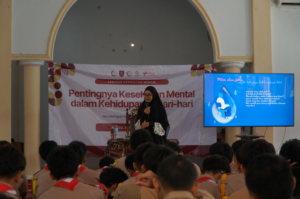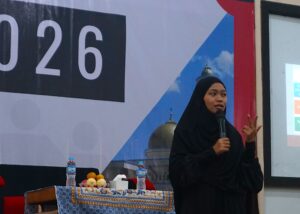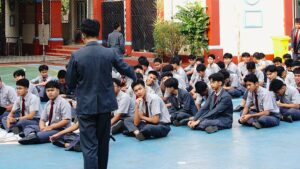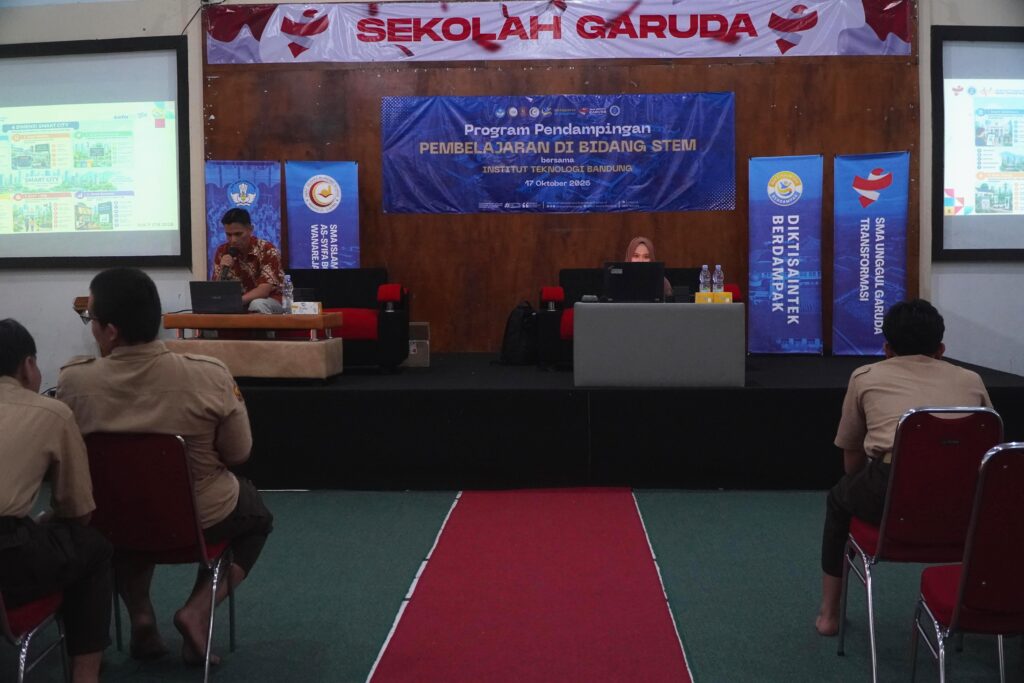
The sound of students’ laughter echoed inside the mosque as they waited for the speaker’s arrival. This time, the university hosting the offline SUGT activity was the Bandung Institute of Technology (ITB). Here, ITB’s role was to handle the enrichment program on STEM, which stands for Science, Technology, Engineering, and Mathematics. Once the speaker arrived, the students began to adjust their seating to listen to the presentation. The material was divided into two locations according to their respective grades. The eleventh-grade students occupied the An-Najah Mosque, while the twelfth-grade students were directed to the Khadijah Hall. The topic delivered by ITB was about the Smart City.
ITB’s Role in SUGT
ITB’s role in SUGT is considered quite significant. As one of the best universities in Indonesia, ITB’s responsibility is to teach STEM subjects. ITB has also prepared this STEM material thoroughly, such as by creating a website called LMS-Lapi, which is used to distribute materials online and monitor students on a scheduled basis. Furthermore, ITB strives to equalize education in relatively remote SUGT schools. The final, yet equally important, role of ITB in SUGT is to prepare students to be ready to compete on a global scale and to possess critical thinking skills.
The Function of STEM on an International Scale
The function of STEM (Science, Technology, Engineering, Mathematics) serves as a framework or core curriculum used in several schools to build students’ critical thinking patterns. This method utilizes hands-on learning, simply known as practical lessons. In this context, students are taught how to use laboratory equipment or create prototypes that are relevant to social issues.
Meanwhile, the function of STEM on an international scale is to prepare students who will solve global challenges, such as the climate crisis, food security, or generally achieving the 17 Sustainable Development Goals (17 SDGs). STEM also prepares the generation for the Fourth Industrial Revolution (Industry 4.0), which heavily utilizes the Internet of Things (IoT) and Artificial Intelligence (AI). This demands that students be able to analyze and solve problems that cannot be replaced by AI, no matter how advanced it is. Finally, the purpose of STEM education is to standardize students’ abilities to be on par with global competencies, prioritizing applied science over mere conventional memorization.
Smart City Presentation with an ITB Lecturer
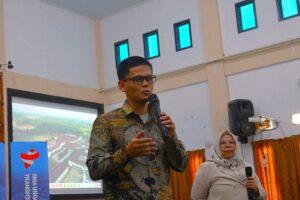
The presentation for the eleventh grade this time was delivered by Mr. Hari Purnama. The material discussed revolved around the Smart City, which is a crucial part of STEM. Within the Smart City concept, there are various case dynamics, both technical and social, making this topic highly suitable to be discussed using critical reasoning in the following segment.
A Smart City is a concept of regional or urban development based on the internet and AI, aiming to create excellent public services and manage resources efficiently. This concept has already been applied in daily life, such as the ETLE (Electronic Traffic Law Enforcement) ticketing system or smart lighting systems that automatically turn on and off based on the system’s control.
Meanwhile, the connection between STEM education and the Smart City is to prepare intelligent human resources capable of comprehensively building an ideal city based on AI and IoT. If this projection is achieved, a Smart City will produce Smart People who can further develop and improve the smart city concept itself.
During this session, the students were briefed on the frequent problems that occur prior to the implementation of a Smart City, such as fires, waste accumulation, and flash floods. Here, Mr. Hari explained that the implementation of a Smart City is incredibly important. He also provided several key formulas that are constantly used in Smart City conceptualization.
After the material presentation concluded, the students were invited to conduct a practical application using an Arduino-based Smart City prototype. The students were taught how to assemble a light sensor that turns on in the dark and turns off in the light. Slowly but surely, the students began assembling the device until it was fully formed. Once the robot was physically built, they started inputting the program to activate the device. When the device successfully lit up during the test, the students were amazed by its capability. After the practicum material was finished, the presentation by ITB was finally concluded. Afterward, the students were directed to return to their dormitories as the call to Asr prayer had echoed.
Through this activity, it is hoped that SUGT students will continue to develop their interests and talents in the fields of technology and science. Hopefully, the knowledge and practical experience gained will not stop in the classroom but can be applied to solve real-world problems in society. Furthermore, this activity is expected to shape an innovative and resilient next generation, ready to pioneer the development of Smart Cities in Indonesia in the future.