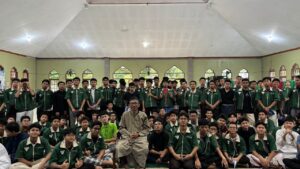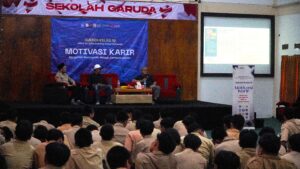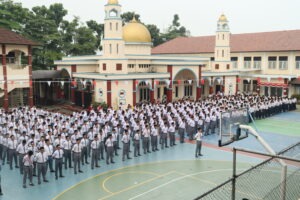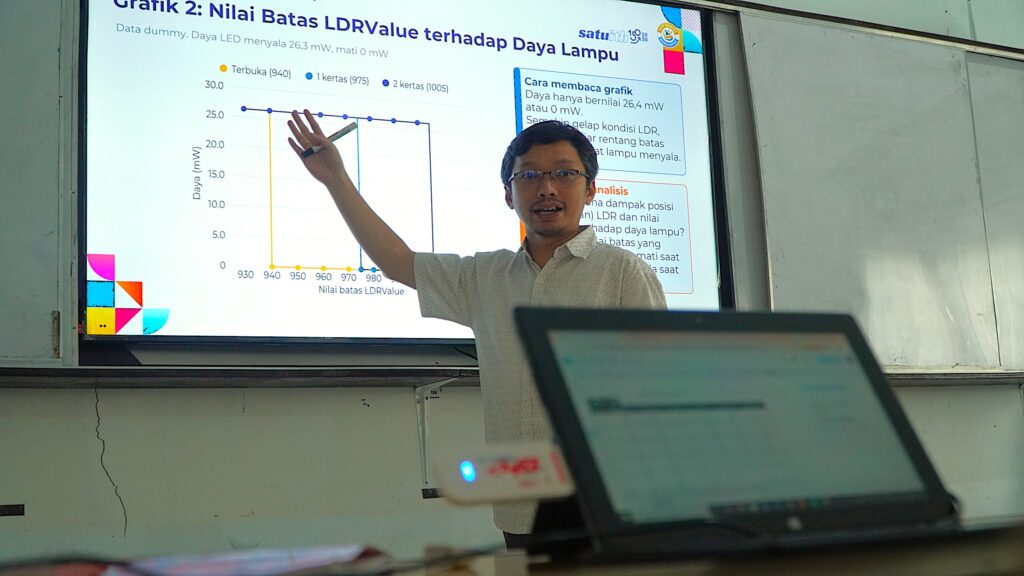
November 7, 2025 — The Bandung Institute of Technology (ITB) once again held an educational STEM session at SMAIT As-Syifa Boarding School Wanareja. This session continued to explore the concept of Smart Cities and featured Muhammad Islahuddin, a lecturer at ITB specializing in Mathematics. The participants consisted of selected students from Scheme 1, Scheme 2, and Scheme 3.
ITB’s Role in the SUGT Program
ITB plays a significant role in the SUGT program. As one of Indonesia’s leading universities, ITB is responsible for providing education in the fields of Science, Technology, Engineering, and Mathematics (STEM).
ITB has also carefully prepared its STEM learning program, including the development of an online platform called LMS-LAPI. This platform is used to distribute learning materials digitally and monitor students’ progress through a structured learning schedule.
Furthermore, ITB strives to promote equal access to education for SUGT participating schools, particularly those located in remote areas. Another important responsibility is to prepare students to compete at the global level while developing critical thinking skills to face various future challenges.
The Role of STEM in the International Context
STEM stands for Science, Technology, Engineering, and Mathematics. It is an educational approach that integrates these four disciplines to develop students’ critical thinking skills. This approach also incorporates hands-on learning, or practical-based learning. Through this method, students are encouraged to use laboratory equipment, conduct experiments, and develop prototypes as potential solutions to various problems in society.
On an international scale, STEM education plays an important role in preparing students to address global challenges, including climate change, food security, and the achievement of the 17 Sustainable Development Goals (SDGs).
In addition, STEM education helps prepare younger generations for Industry 4.0, which increasingly relies on technologies such as the Internet of Things (IoT) and Artificial Intelligence (AI). These developments require students to develop analytical skills, critical thinking, and problem-solving abilities that involve human creativity and reasoning.
Finally, STEM education also aims to align students’ competencies with global standards, which increasingly emphasize the practical application of scientific knowledge and skills rather than relying solely on conventional memorization-based learning.
A Learning Session with Muhammad Islahuddin
The learning session took place in one of the classrooms at SMAIT As-Syifa Boarding School Wanareja. While waiting for the speaker to arrive, students chatted with one another and discussed the materials from the previous session. On the tables, the RBL equipment used in the previous meeting and SUGT learning modules had already been prepared.
As time passed, Muhammad Islahuddin finally arrived in the classroom. The session began with a brief introduction before moving on to the main topic.
Getting to Know Muhammad Islahuddin
Muhammad Islahuddin, commonly known as Mr. Islah, is a Mathematics lecturer at the Bandung Institute of Technology (ITB). He is an ITB graduate who continued his postgraduate studies abroad, pursuing both his master’s and doctoral degrees.
He completed his master’s degree at TU Kaiserslautern in Germany. Meanwhile, he pursued his doctoral studies at KU Leuven in Belgium, where he is currently undertaking his doctoral research.
Applying Mathematical Formulas to Smart City Concepts
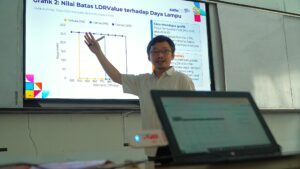
Dr. Islah began his presentation with a few jokes to create a more relaxed classroom atmosphere. The main topic focused on applying mathematical formulas to the development of Smart City concepts.
Several formulas are used in the implementation of these concepts. One example is a formula in the Science category, namely E = A × r × Pr, which is used to calculate solar panel energy. In addition, other mathematical formulas related to Smart City applications were also introduced.
The students actively followed the presentation. From time to time, several students raised questions about the steps involved in solving problems using the formulas explained during the session.